
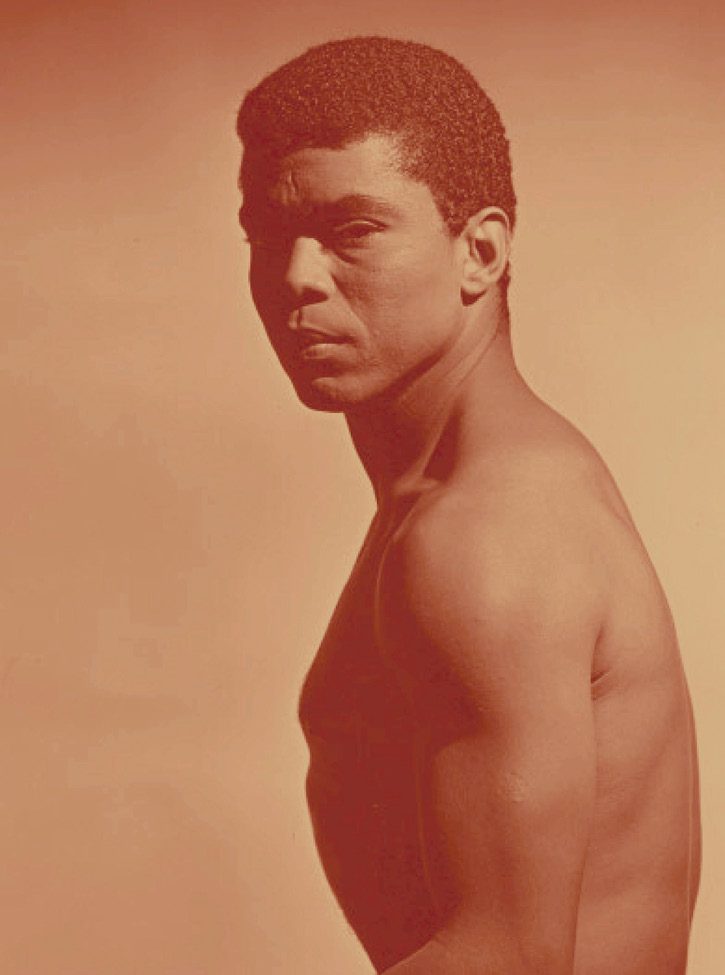
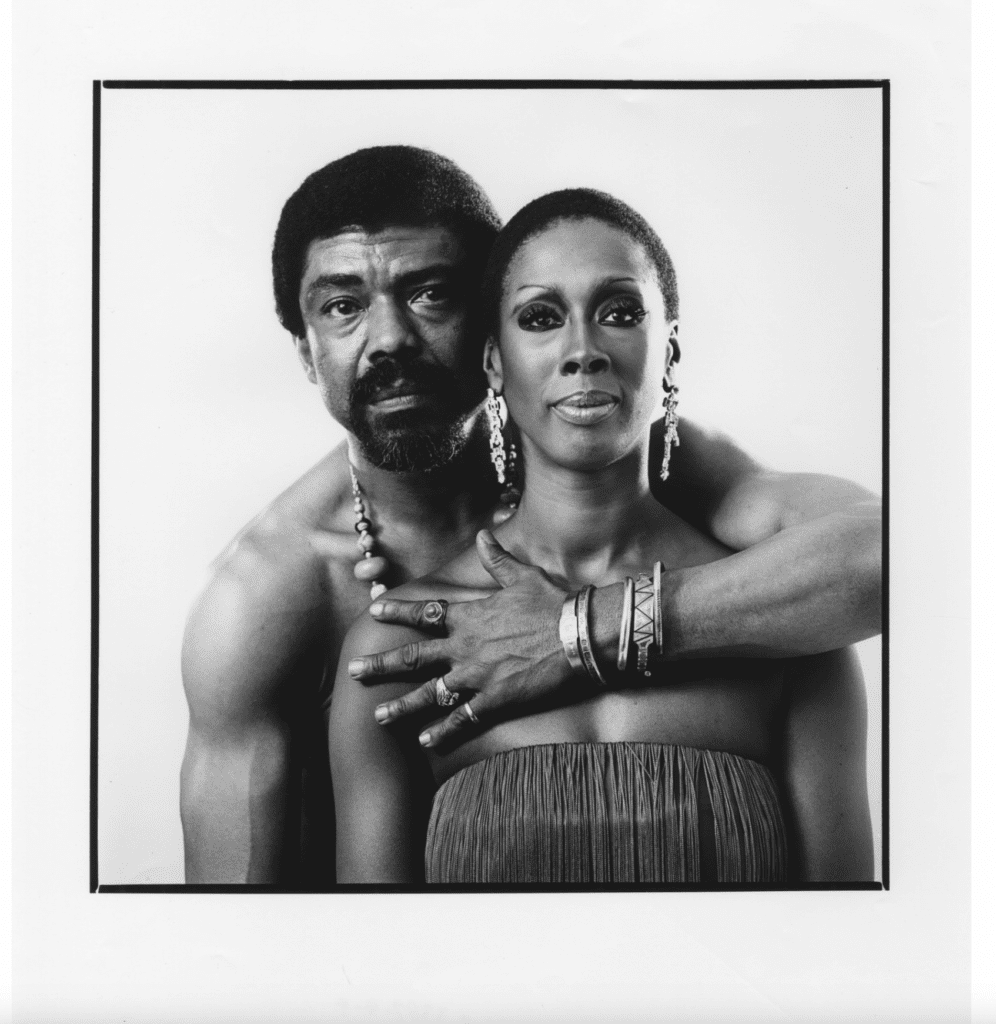
If you’ve seen any photographs of the choreographer Alvin Ailey (1931–89), it is quite likely that one of them was by Jack Mitchell, whose archive of Ailey photography (now at the Smithsonian’s National Museum of African American History and Culture) includes over 10,000 black-and-white negatives and 1,300 color slides and transparencies. Within this archive is a subarchive of double portraits showing Ailey and his cherished leading dancer, Judith Jamison, taken in the 1970s. They are positioned very close together, with Ailey, facing the camera, behind Jamison, who is in profile. Ailey meets the lens long past his prime dancing condition; in some of the pictures, he looks exhausted and even paunchy, his emotions close to his skin. Jamison, in contrast, is simply gorgeous, unflappable, and betrays no signs of aging at all. The idea of the imagery—a long-lived one in world culture—seems to be that artists are human but muses are divine.
After Ailey’s physical death from AIDS at fifty-eight, it went almost without saying that the company’s direction would be entrusted to Jamison, and, throughout her tenure, she proved, devotedly, to earn the appointment. Jamison danced for Ailey between 1964 and 1988, and she served as his company’s revered artistic director (and an in-house choreographer) between 1989 and 2011. I write these words one day after the announcement that Jamison has died, at the age of eighty-one. Remembering Mitchell’s double portraits, I can’t help feeling that, with her passing, some part of Ailey has died once again too.
A few of Mitchell’s pictures (though I don’t believe any of the double portraits) have made it into Edges of Ailey, the catalog for the Whitney’s current mammoth, glamorous, and risk-taking exhibition of the same name (on view until February 9, 2025). The show has plenty of materials on Ailey’s dance and dancers; however, its big picture is not about choreography as such. Instead one finds that Ailey’s identity and legacy are shown to go far beyond the art of dancing: his life and works are presented as symbols of Black art in America in the twentieth century and as a summation of philosophies regarding and perspectives on the African American experience overall.
Ailey’s identity and legacy are shown to go far beyond the art of dancing.
The exhibition’s range of media and topics is breathtaking. Its objects and live presentations—including an overwhelming ribbon of performance films, theatrical objects, vitrines of the choreographer’s manuscripts, and artworks by other famous African American artists from Jacob Lawrence to Lorna Simpson—unspools and spills throughout the Whitney’s entire fifth floor. They are joined by performances, panels, and classes in the Susan and John Hess Family Theater and Gallery, and by this doorstop-size souvenir catalog in the bookstore. Put together over the past six years by the museum’s chaired senior curator Adrienne Edwards and a formidable staff, the show attempts to outdo more selective museum exhibitions on dance, such as the Judson Dance Theater: The Work Is Never Done and Lincoln Kirstein’s Modern, both at MOMA in 2019, and the various ingenious performance programs that engage the collections of art at the Metropolitan Museum of Art. The exhibition Edges of Ailey stretches to set a standard of abundance for how dance might be treated at an art museum.
The result, for this observer, is awe at the energy involved in the making. This sensation is captured as well in the exhibition catalog, yet I also feel some uncertainty as to whether the representation on the front of the catalog’s dust jacket of Ailey as a medieval icon, his handsome yet serious (and already stressed) face emerging from a background of undivided gold, opens the choreographer’s interior to us or flies him far off into eternity. This heavenly portrait of Ailey, appearing almost as a saint, is also by Jack Mitchell.
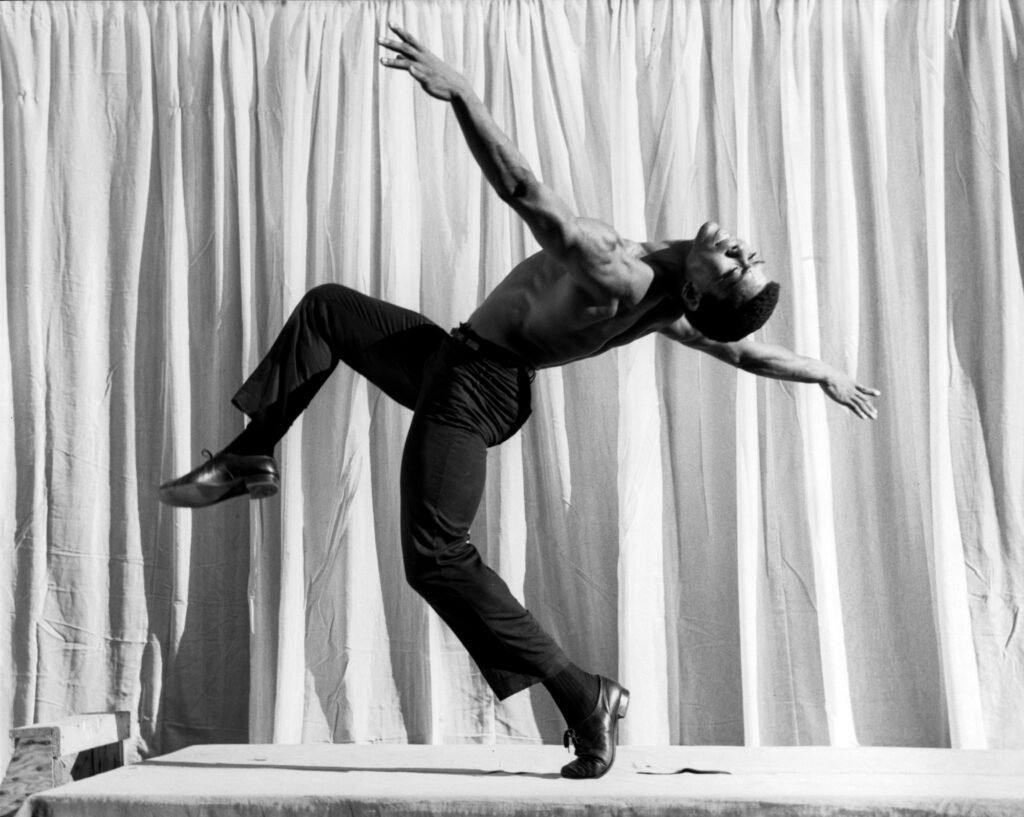
On the back of the jacket are angelic scenes of dancers—a boyishly exuberant Ailey among them—from the legendary all-Black cast in the 1957 Broadway musical Jamaica starring Lena Horne and with choreography by Jack Cole. And then, beneath the golden dust jacket, is another view of Ailey. Running across the book’s black front and back covers, from edge to edge, is a ghostly moment extracted from a photo by John Lindquist of Ailey actually dancing—or rather, momentarily flatte ned, eyes closed and body just about pulled asunder, in a fragment of dance performance, both death defying and deathly. The contrast of the dust jacket and the cover alone sets off stark, unworded suggestions about the mixed values of art and history, performance and offstage life, Blackness and the world that point to the tremendous intellectual and emotional territory Edges aspires to encompass. As museum catalogs go, this one is a browser’s treasury. One needn’t read anything—or even be an English-language speaker—to enjoy it.
That said, the catalog also contains tens of thousands of words. Many are in essays by university professors, whose vocabulary is so technical and multisyllabic that anyone who completes all the reading should be awarded at least a credit toward graduate school in dance studies. The technical dimension discussed though is rarely about dancing—and even when the words relate to what dancers actually do in a dance, they are not drawn from modern dance or specific dance practices from Africa or the West Indies, which infused Ailey’s choreography, but exclusively from classical ballet. The other dance words in these essays are about ideas related to dancing: “embodiment,” “stylistic dialogism,” and so forth. The ideas are provocative and often lead one to ponder their implications, but the process is a bit tedious, like trying to master trigonometry. Arranged in a slyly chronological order, the writings in the catalog are educational and varied, but they’re not quite a walk in the park to read. Partly that’s a function of how they’re written and also of how they’re published. The font throughout is sans serif, and it’s delicate and small: To complete the long paragraphs, one needs strong light, lots of time, a clear mind, and a strongly focused attention.  The article on dance data by Harmony Bench and Kate Elswit is a case in point. The dense text is complemented by foldout colored charts that graph the locations Ailey’s dancers performed and taught over time, thereby transmitting body-to-body information across the globe. These graphics are beautiful and yet they don’t quite render the information immediately intelligible, which is presumably the illustrations’ purpose.
For readers who want to work up to some of these more heady entries, I suggest starting with five very digestible ones: the nearly thirty-page chronology by the Met Museum research associate CJ Salapare, which serves as a biography of Ailey, a chronicle of his company, and a glimpse of his legacy; the brilliant overview essay by curator Adrienne Edwards; the transcripts of two discussions between dancers and historians—one representing the 1960s and ’70s, and the other Ailey’s impact on American dance in the wake of his death; and, my favorite essay in the book, “dear alvin,” by choreographer, historian, and erstwhile Ailey archivist Thomas F. DeFrantz—a stunningly honest and deeply personal direct address to Ailey himself, which gently yet decisively explains what dancers and choreographers who came to Ailey’s work after he had died find so affecting and how they are also able to remain unsentimentally detached. When dealing with an artist of this magnitude, a certain abstraction is necessary in order to move on with life and create art within one’s own cultural context.
This hello-goodbye to Ailey is mirrored in the exhibition itself by the extensive collection of sculpture, painting, and art on paper, much of it made after Ailey’s death yet demonstrating that, even in the future Ailey didn’t live to witness, the themes and “blood memories” of his unique past continue to persist and to resonate in the bodies and brains of new artists, even if not in their modes of expression. Ironically, and to some measure triumphantly, in light of Edges of Ailey’s reason for being, it is the images of the static art—the paintings and sculpture that art museum catalogs normally serve—that lose their expressive force in this book tribute to a dancer and his world. To feel that conversation among artists fully, photos of the artworks aren’t enough. One must stand with the works in person, amid strangers, and become a living embodiment of an audience in real time.
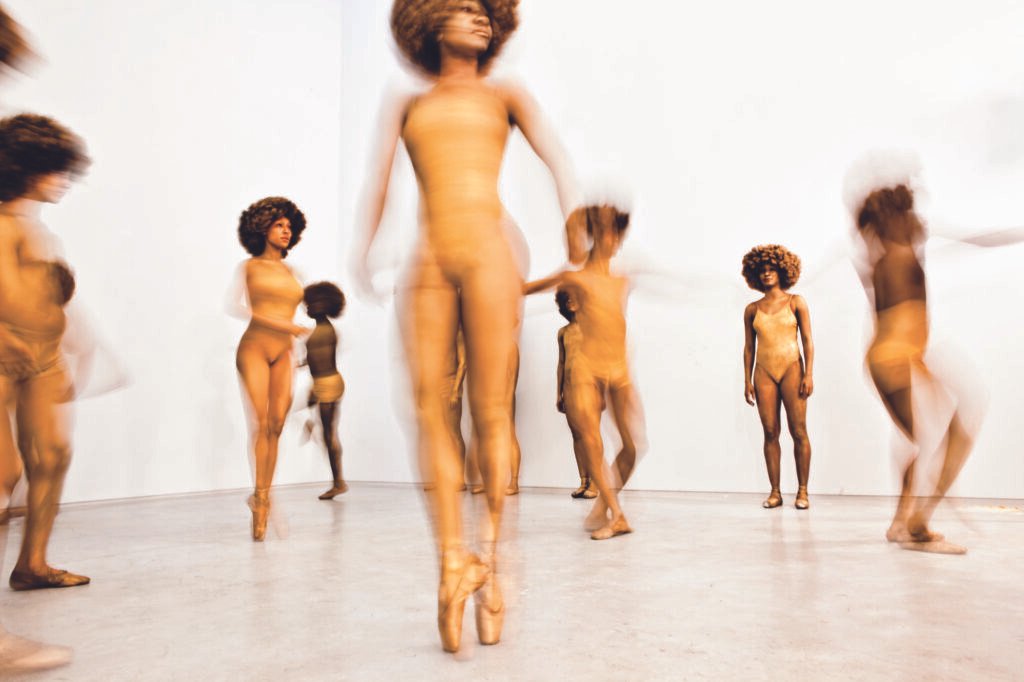
© Lorna Simpson. Photo courtesy of the artist and Hauser & Wirth.